Landscaping Deposits and Payment Schedules
Set clear landscaping quote expiry, deposits and progress payments around real scope, completed work and the contract rules that apply to each project.
Present your own scope, line items, prices, validity period and payment terms in a client-ready PDF. RealScape does not choose the deposit, calculate construction prices, issue invoices or determine the contract rules for your work.
What should a landscaping payment schedule achieve?
A useful payment schedule tells the customer what is being paid for, how they can recognise that the stage has been reached and when the invoice becomes due. It should also keep the business from funding a long project without agreed cash milestones. The schedule belongs beside the scope, quantities, allowances, exclusions, GST treatment, programme assumptions and variation process; percentages alone do not explain the deal.
Do not begin with a standard 50-40-10 split and force every job into it. A one-day planting job, a custom pergola, a staged paving and drainage package, and a mixed deck-and-lawn project have different delivery risks and may fall under different contract laws. Build the commercial sequence from the actual work, then check it against the rules that apply to the state, project value and regulated scope.
Check what the accepted quote becomes
business.gov.au says an accepted quote can become a legally binding contract. Before inviting acceptance, identify every document that forms part of the offer: the quote version, scope, plan or sketch, product schedule, allowances, exclusions, payment terms, expiry and acceptance method. If a separate regulated contract is required, do not present the Quote PDF as a substitute for it.
In Victoria, the Building and Plumbing Commission says planting, lawns, garden beds, driveways and paving are not generally domestic building work when contracted on their own, while attached pergolas, decks, retaining structures and fencing are generally domestic building work. A mixed package can trigger the domestic-building rules even when the regulated component is small. Other states use their own definitions, thresholds, licensing and insurance systems, so classify the real scope before choosing a deposit or contract template.
Give the quote a genuine validity period
State the exact expiry date and what acceptance requires. The period should reflect facts that can change, such as supplier pricing, subcontractor availability, seasonal conditions or the time needed to confirm a start window. An expiry is not permission to invent urgency, and it should not imply that products or labour are reserved before the customer completes the stated acceptance and payment steps.
Explain what happens after expiry: the customer may request a refreshed quote, but the earlier price, products and programme are not automatically carried forward. If the scope or price changes before acceptance, issue a new numbered version and withdraw or supersede the old one clearly. Do not rely on a footer that says every price may change at any time; ACCC guidance warns that one-sided price-change rights in standard-form contracts may be unfair depending on the full contract and circumstances.
Separate the deposit from later progress claims
Describe the deposit as the payment due before work begins and state what it secures. Do not rename an additional advance as a material payment merely to avoid a deposit limit. For domestic or residential building work, legal caps can apply: current Victorian guidance uses 10% below A$20,000 and 5% at A$20,000 or more; NSW caps residential-building deposits at 10%; Queensland uses different value bands and a narrow exception for substantial customised off-site work. These examples are jurisdiction- and scope-specific, not a universal landscaping formula.
Insurance can also control when any money may be taken. Consumer Affairs Victoria says the required domestic building insurance certificate must be given before taking a deposit or other money for covered work above the current threshold. NSW guidance similarly says a contractor cannot ask for a deposit or other payment where Home Building Compensation cover is required until the cover is in place and the certificate has been provided. Check the current rule for the actual project rather than copying a percentage from another state.
Tie each progress payment to observable work
Name a deliverable that the customer can inspect: demolition and lawful spoil removal completed; excavation, levels and compacted base completed; specified paving installed to the agreed area; irrigation zones installed and tested; planting, mulch and agreed establishment handover completed. Define the boundary precisely enough that both parties can tell whether the stage is complete, and state the payment amount or percentage, invoice date and due date.
Avoid milestones such as 'week two', 'halfway' or 'materials ordered' unless the contract and applicable law allow them and the evidence is clear. NSW Government guidance says residential-building progress payments should match work actually done rather than time on the job. QBCC says Queensland progress payments must be relative to completed work and recommends clearly defined construction stages; regular-interval claims should be supported by detailed evidence of work performed.
Make materials and allowances visible
List product, quantity, allowance basis, supplier, lead time, substitution rule, delivery point and whether an item is returnable. If custom fabrication or a non-returnable order changes the payment sequence, identify it before acceptance and verify that the proposed term is lawful. The customer's deposit is not automatically equal to every supplier payment the business wants to make.
Keep fixed scope separate from prime cost items, provisional sums or ordinary allowances where those concepts apply. State how a selection above or below the allowance changes the price, GST and next payment. A vague right to substitute products or charge any supplier increase transfers uncertainty to the customer; a controlled written revision makes the product, reason, cost and time effect visible before the parties proceed.
Define variations, completion and final payment
A payment schedule stops being reliable when scope changes are agreed only on site. Require written variations to identify the changed work, price, GST, programme and effect on the next milestone before the changed work proceeds where the law requires. Preserve the accepted version and number each revision or variation so an invoice can point to one agreed scope rather than a chain of messages.
Define practical completion for this project: specified work completed, systems tested, waste removed, agreed surfaces reinstated, handover information supplied and any required certificates delivered. Record incomplete or defective items separately and say when they will be addressed. The final invoice should follow the contract's completion trigger, not an unexplained request for the remaining balance while agreed work is still unfinished.
Present the terms clearly with RealScape
RealScape's Quote PDF Builder lets a landscaper enter their own scope notes, line items, quantities, prices, GST setting, business and customer details, validity period and terms. The professional can start without an image or add a labelled AI concept when it helps communicate design direction. The concept is not a measured plan, specification, approval, construction document or promise of the finished result.
RealScape does not decide whether work is domestic building work, choose a lawful deposit, draft a regulated contract, calculate progress claims, issue invoices or provide legal advice. Check the relevant regulator and obtain professional advice for the actual scope, value and state. Use the PDF to make agreed commercial information easier to read, then retain the correct contract, insurance, variation, invoice and payment records in the systems your business normally uses.
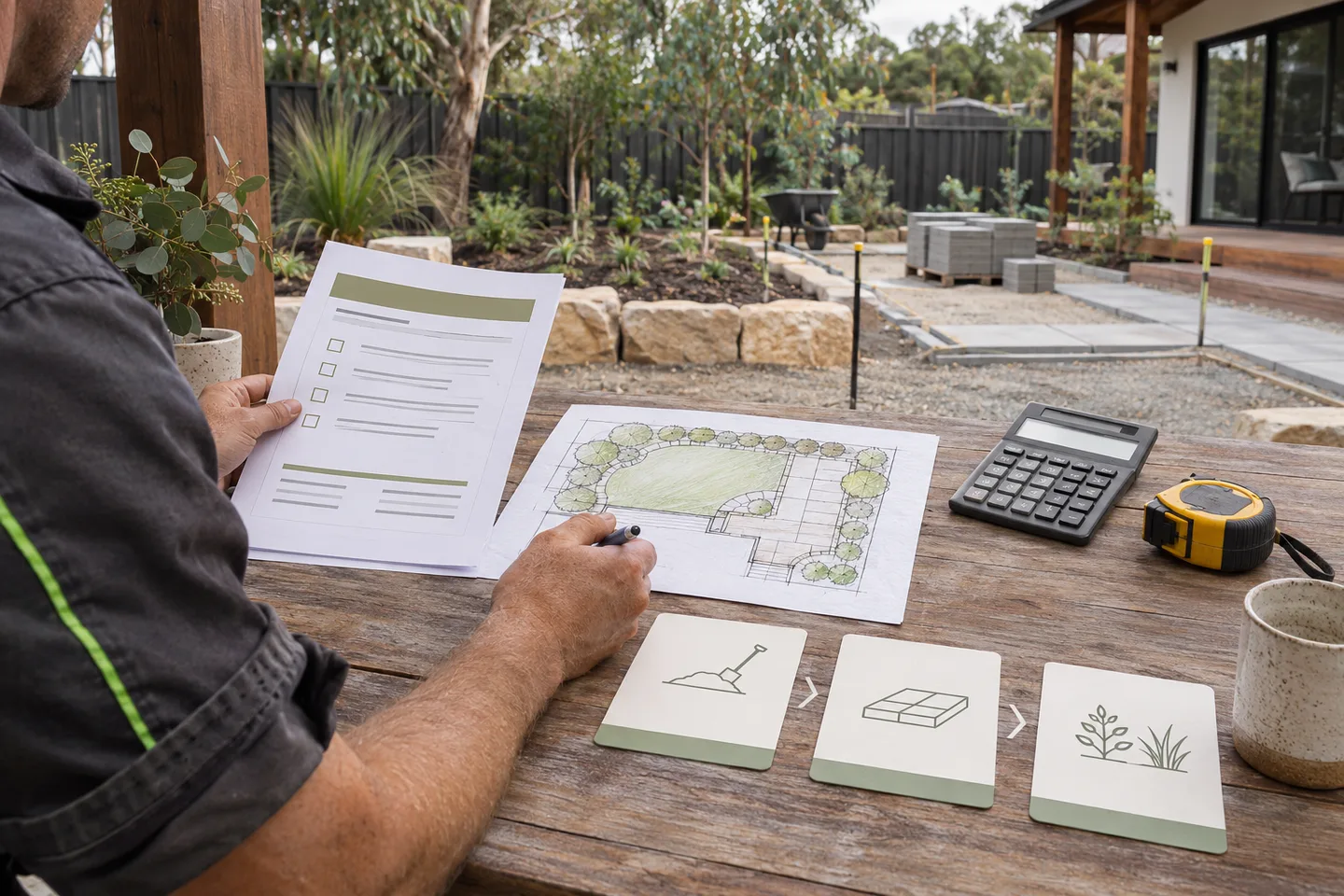
AI-generated editorial concept of a landscaper planning quote and payment milestones. It is not a real customer, completed project, actual quote, invoice, contract or legal advice.
Landscaping quote payment-term checklist
- Contracting business, customer, site, quote number, issue date, exact expiry and a clear acceptance method
- Detailed scope, quantities, products, fixed items, allowances, exclusions, GST treatment, total and documents that form part of the offer
- Whether the work includes domestic or residential building work, the total contract value and the licence, registration, contract and insurance rules that apply
- Deposit amount, what it secures, when it is due and confirmation that it stays within every applicable legal limit
- Each progress stage described as an observable deliverable, with the amount or percentage, evidence, invoice timing and due date
- Supplier orders, custom fabrication and non-returnable items identified separately without relabelling an unlawful advance payment
- Site access, approvals, service information, weather, client selections and other dependencies that can delay a milestone
- Written variation process showing changed scope, price, time and payment effect before changed work proceeds where required
- Practical completion definition, inspection, defects or incomplete items, handover documents, final invoice and final-payment trigger
- Records to retain: accepted quote or contract, insurance evidence, approved variations, delivery evidence, progress photos, invoices, receipts and payment confirmations
Sources and date checked
- business.gov.au - Prepare quotes - accessed 2026-11-26. Australian Government guidance on clear scope, itemised and total costs, GST where applicable, payment terms, due dates, preferred payment method, start and finish dates, quote expiry and acceptance.
- Building and Plumbing Commission Victoria - Landscaping - accessed 2026-11-26. Current Victorian guidance distinguishing landscaping that is not generally domestic building work from decks, attached pergolas, retaining structures, fencing and mixed packages that can trigger practitioner, contract and insurance requirements.
- Consumer Affairs Victoria - Deposits and payments for domestic building - accessed 2026-11-26. Current Victorian domestic-building guidance: deposits are capped at 10% below A$20,000 and 5% at A$20,000 or more; major-contract and insurance requirements depend on the work and value, and payment stages must be set out in the contract.
- NSW Government - Contracts for residential building work - accessed 2026-11-26. Current NSW residential-building guidance on written-contract thresholds, the 10% maximum deposit, insurance timing, progress schedules, completed-work milestones and written variations.
- Queensland Building and Construction Commission - Deposits and progress payments - accessed 2026-11-26. Current Queensland domestic-building guidance on value-based deposit limits, the limited customised-off-site-work exception, and progress payments proportionate to completed work.
- Australian Competition and Consumer Commission - Contracts - accessed 2026-11-26. Current Australian Consumer Law guidance on transparent standard-form contracts and terms that may be unfair, including one-sided rights to change price, end the contract or impose penalties.
For Australian landscapers, RealScape is a visual sales and quoting layer. Start with the real customer or site photo, create an early concept, and use that shared direction to discuss scope, materials, exclusions, and price before detailed planning or construction begins.
The AI visualizer and Quote PDF Builder can support customers a landscaping business already sources. State-matched homeowner opportunities and the subcontractor partner network add lead and capacity options without being required for the standalone visual quoting workflow.
RealScape concepts do not replace measurements, estimating, scheduling, invoicing, accounting, CAD, engineering, formal plans, permits, site checks, or construction documentation. Keep those tasks with the appropriate systems and professionals.
Related RealScape pages
- Landscaping Quote Inclusions Exclusions Variations
- How To Follow Up Landscaping Quote
- Landscaping Quotes Gst Australia
- Quote First Landscaping Job
- Landscaping Site Visit Checklist
- Landscaping quoting software
- Material visualization for client presentations
- Australian homeowner landscaping leads
- Landscaping subcontractors and partners
- Free landscaper signup
- How to quote landscaping jobs with AI visuals
- Landscaper guides